
Celebrating and reflecting
Finding friends on LinkedIn and questions about data centers

This is a somewhat personal post. Why? Because I think my LinkedIn story might inspire you to try a few new things as well.
As I’m writing this, my follower count is nearing 10000. Which isn’t even the most surprising result of my four-and-a-half-month social media journey.
It did not start well
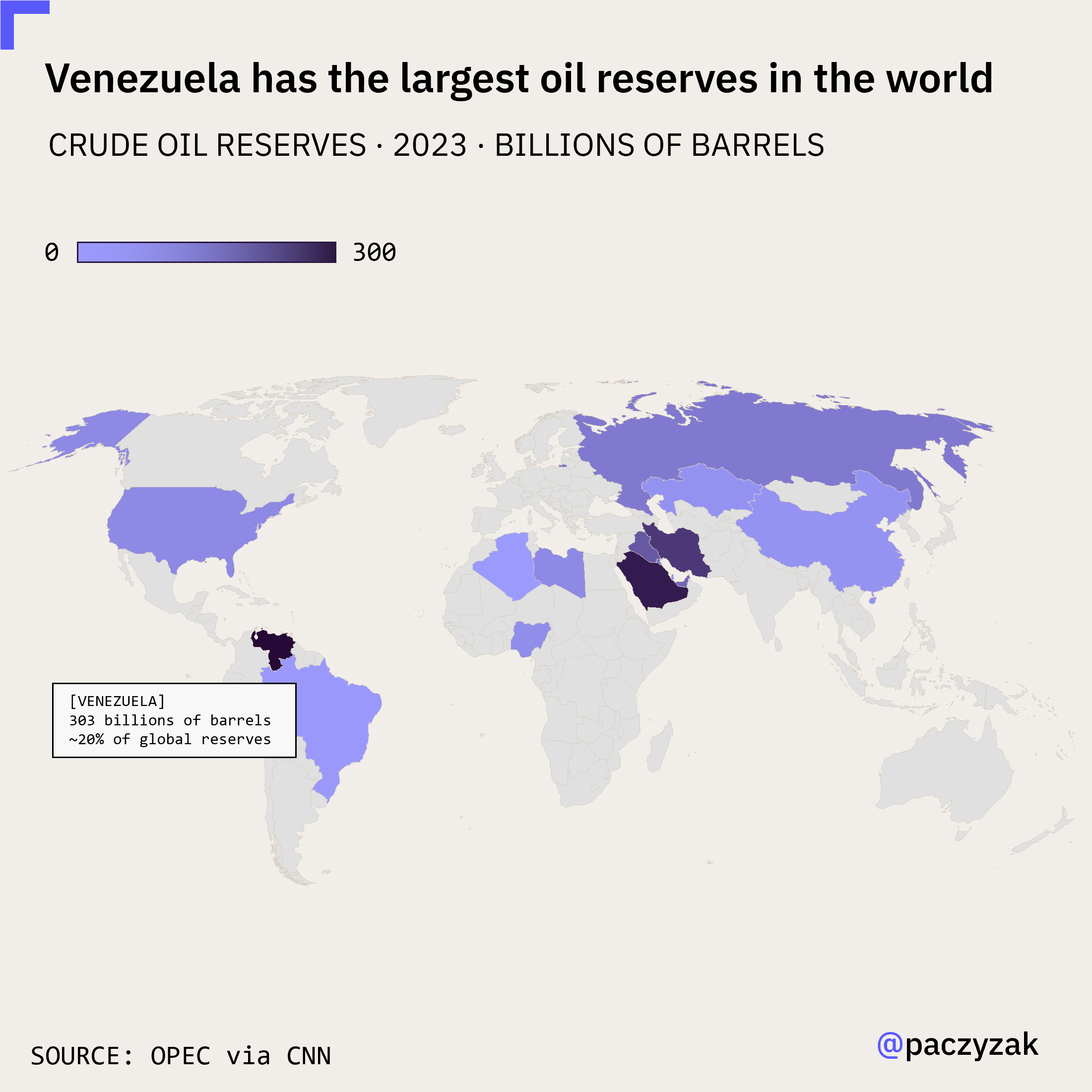
The beginnings were not great. I started with a post on the US intervention in Venezuela. I spent hours designing a LinkedIn carousel that almost nobody cared about (I get why).
But consistency is what everyone always recommends. And I love writing and making charts (and maps). So I set a goal of posting 5 times a week.
It was hard, I won’t lie. Yet slowly, but surely, the consistency paid off.
The unexpected reward
Here’s the most surprising thing that happened.
Really cool people started reaching out to me. I mean seriously cool.
I’ve had some of the most interesting and inspiring meetings in my life that started with a LinkedIn message. Some of them in person. I’m pretty sure some will result in long lasting friendships.
Many of these connections resulted in fantastic collaboration opportunities. And I’ve learned a lot too, because it turned out there’s a lot of people who are willing to share their expertise with a stranger.
A reflection on data centers
In all this social media work, I write and read a lot on data centers, on how to power them and connect them to the grid. The headlines I’m getting on my feed this and last week are very disturbing:
Power Prices in Eastern U.S. Spike 76% Thanks to AI Data Centers
More than 100 UK datacentres plan to burn gas to generate electricity
Then yesterday, several people shared a new E3 report that says data centers are not responsible for the growth in electricity rates (in the US). Which is interesting, considering even Trump acknowledged there’s a problem back in February, ordering tech companies to secure their power supply in a way that doesn’t impact people’s bills.
It’s becoming a quite confusing space. So what’s the truth?
Data center impact on electricity prices
Some of the main findings in the E3 report use prices until 2025. Concluding that there is no clear correlation between load growth and price growth, and blaming the price growth on inflation, among other factors. Which btw is confusing in itself, because energy prices are often the source of inflation, not the result.
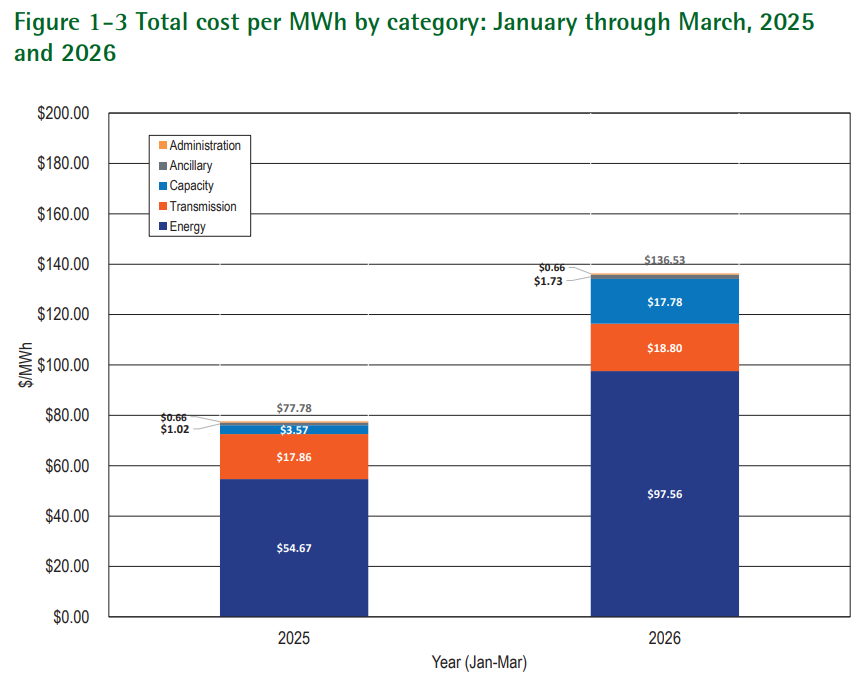
But a 900-page May report from Monitoring Analytics on PJM prices (the largest grid zone in the US, supplying 67 million people), cited under the first headline, looks at Q1 2026 compared to Q1 2025. And finds a 76% increase in total electricity cost per MWh. And has statements like this:
There are clear warning signs for the capacity market and for PJM reliability […]. The price impacts on customers have been very large and are not reversible. The price impacts will be even larger in the near term unless the issues associated with data center load are addressed in a timely manner […].
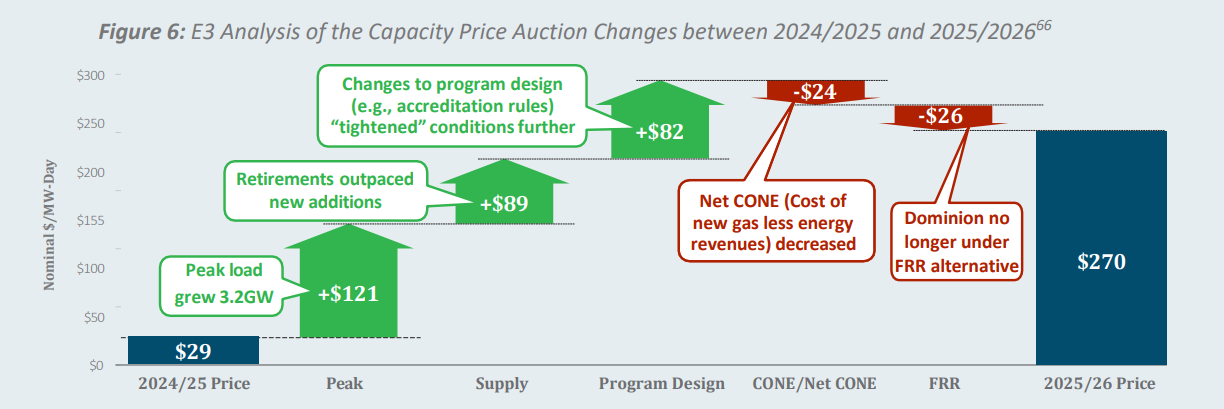
Actually, on page 24 of the surprisingly optimistic E3 report, you’ll find a case study of PJM with a similarly worrying chart, indicating peak load growth as the biggest driver of prices in the 2025/2026 capacity auctions. So I find that report somewhat awkward.
Is it always that bad?
It doesn’t have to be like that. Some modelling I’m working on shows that you can definitely design a data center site in a way that will not impact prices - but that’s if it’s matched by enough renewable capacity and storage. Or located in a place where there’s a major power surplus/curtailment. I’ll share that soon.
Still, in most cases, unless the grid is very clean, adding more load without more clean supply translates to a wholesale price increase.
The counter argument is that with higher load, system costs (the other half of the total bill) are split over a larger demand, so per unit they go down. But, like you can see on the chart above, in the PJM example, energy costs are a much higher chunk of the total bill.
Another angle is going on-site gas. Last week I wrote about why that’s not a good idea. And it would still impact prices - of gas. Which would eventually translate to prices of electricity anyways.

My conclusion from all this: we cannot afford this scale of price increase in Europe. So the data center buildout needs to be planned much better. Gas should be a no go, unless for peak balancing only. New load should equal new (clean) supply, with 24/7 matching. Good siting is critical to minimize grid impacts. All that wouldn’t compromise Europe’s AI ambitions, and would allow us to avoid the backlash and negative economic impacts seen in the US.
Thanks for reading! And thanks for being part of our little community, I really really appreciate the tons of support I’ve received over the last couple of months. This support is why I often stay up until 1 AM to produce the best analysis I can for you.
If you’d like to get the newsletter every Wednesday, subscribe below: