

It started with an announcement in May 2024: xAI needed 100 000 GPUs to train the latest version of Grok. In June, a site was selected - a former Electrolux factory in Memphis. In September, Elon Musk stated that the Colossus started operations - from start to finish in a blistering 122 days. It wasn’t really the “finish” though.
Quick and dirty
At that point, the site ran at around 200 MW. With a 8 MW grid connection.
In February 2025, the site was running at 360 MW.
So where did the missing power come from?
On-site gas turbines. These were supposed to be temporary. But in January 2025, xAI filed for a 2-year air permit for 15 turbines, around 250 MW in total. The permit was granted in July 2025. Until July, they ran unpermitted.
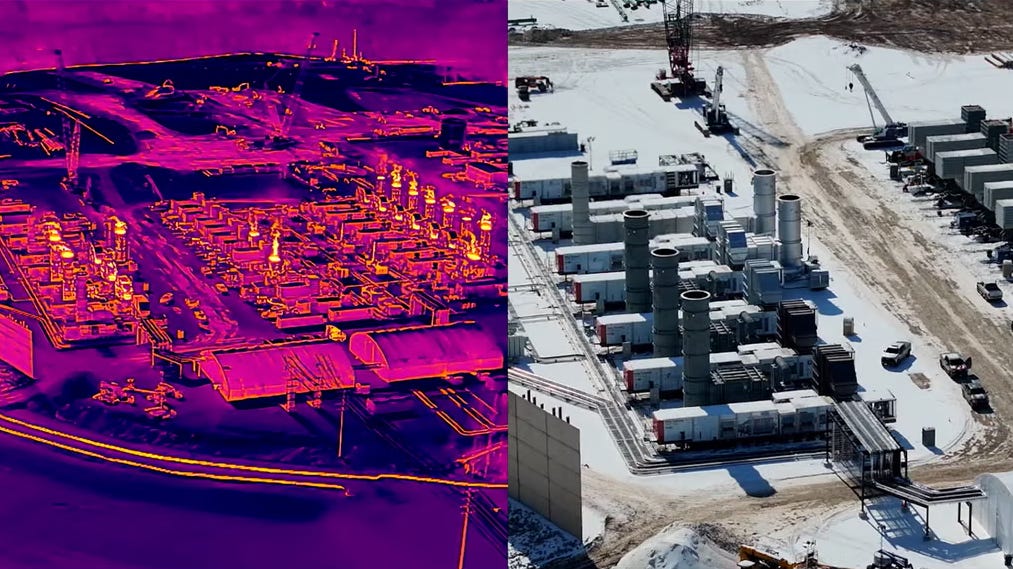
Here’s a quote from the Southern Environmental Law Center on the environmental impact:
The number of turbines and extent of their emissions likely make xAI the largest industrial source of the smog-forming pollutant NOx in Memphis
So indeed, the project was deployed very quickly, but the environmental impacts and the social backlash are not something I’d consider best practice. Certainly not something we’d want in Europe. In fact, xAI was recently sued for similar practices with the Colossus 2 project.
Powering the Colossus
Diving a bit more into the power supply. After the initial 8 MW grid connection, xAI received 150 MW of grid capacity through a second substation in March 2025. Another 150 MW was made available through a third substation in the fall of 2025. Which means it took less than two years for the full grid connection.
And actually, it’s not really “full” - the site is running at 425 MW according to Epoch.AI, so there’s over 100 MW missing, which I’ve not found any explanation for.
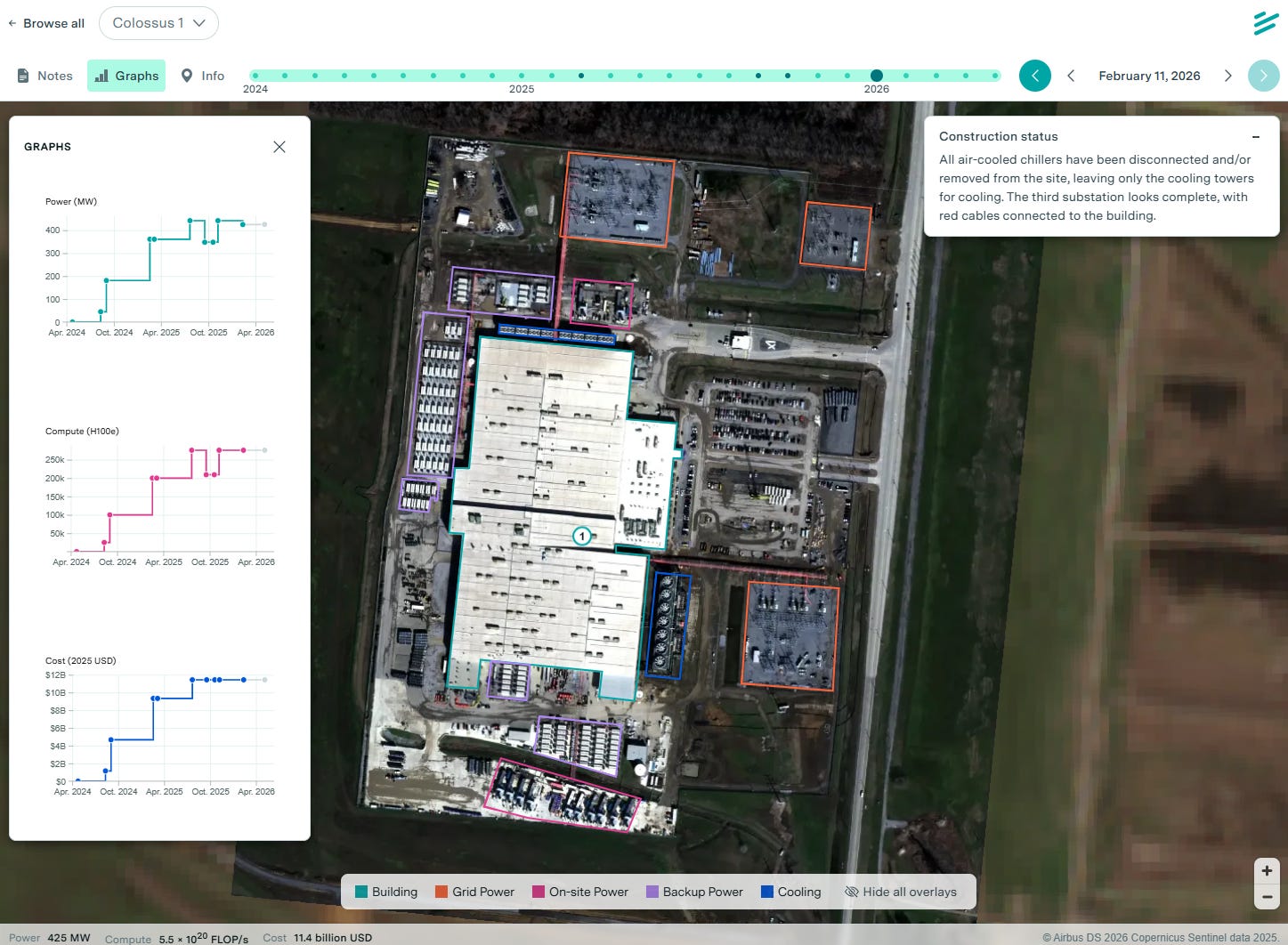
In March 2026, a 30 MW solar farm was added to the site. Earlier, 168 Tesla Megapacks were added as well - battery storage units with a total capacity of 655.2 MWh. That’s massive: double what all of Spain had end of last year.
These are steps in the right direction. But was there another path, one that would’ve avoided the environmental harm and social damage, without compromising speed?
Quick and clean(er)?
For starters, I’m not sure why xAI selected a site with a 8 MW grid connection for a 400 MW project. Probably to reuse the existing building. But normally I would start the site selection process by looking at grid capacity and finding a place where say 80-100 MW is available straight away. That’s lesson number 1.
More on-site solar
Let’s look at the site once again. It’s in an industrial area, close to a power plant and a waste treatment plant. The Colossus facility is surrounded by fields / grassland. Considering the neighbors, I don’t think those fields are used for growing carrots.
In total, it’s around 169 hectares. Using the same power density as in that 30 MW solar array, the 169 hectares could house 140 MW of solar in total. And considering the 30 MW farm was built in 2 months, I imagine in a hurry you could get 140 MW done in 122 days. Well, without permitting, but this, as we know, was considered optional anyways.
That solar could cover around 15% of the site’s annual electricity demand, bringing the emissions intensity down in the process and helping us with the next steps. That’s lesson number 2.
The batteries
The battery storage system is typically only used as backup - like a giant UPS. But it could be used to lower the on-site gas needs / shift the power load / lower the electricity costs (through arbitrage). That’s lesson number 3.
Adding flexibility
Lesson number 4. If we reduce the IT load by 25% when the power grid is most stressed, that could accelerate the grid connection by years. Say we do it only when the grid is above 90% of its peak load. That’s just 200 hours in a year - 2.35% of the time. Which should hardly be a problem for a AI training facility. If you had to, you could cover that with the on-site gas.

Summing it all up
In that hypothetical scenario, you could still be able to get the first phase going in months, using 50 MW of gas turbines instead of 250 MW. With the battery setup that was deployed anyways, a bigger solar system, and very conservative demand flexibility to secure a faster grid connection.
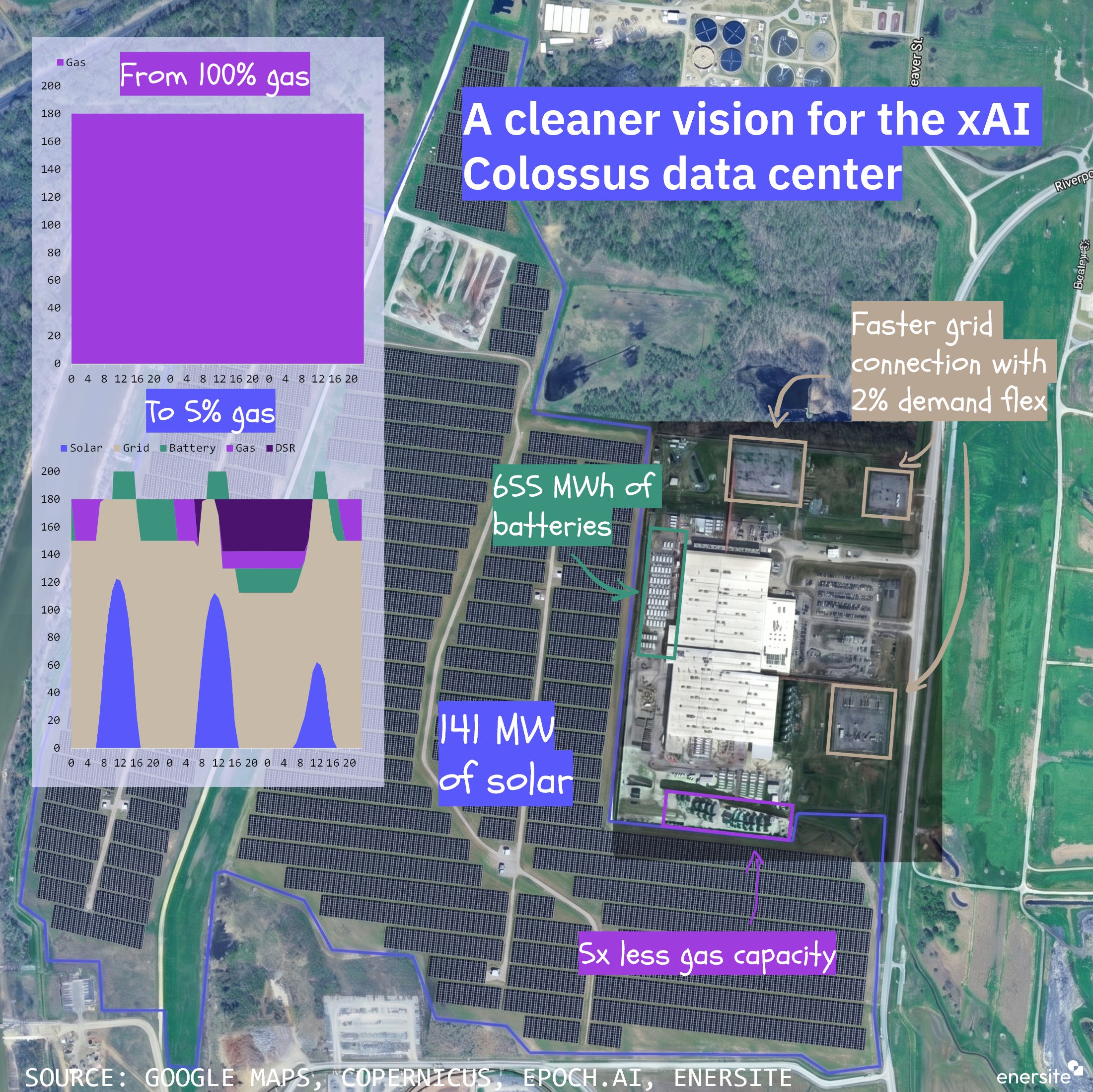
The benefits: cutting gas power from 100% in the first phase (so until the first 150 MW grid connection was made) to 5%. Cutting the gas fleet capacity 5 times. Cutting the annual emissions in half.
Plus not annoying local residents and not getting sued.
This is of course a simplified analysis. Results will depend on the location, the grid, the grid operator, the power market. And I would anyways start by choosing a better site.
But even in this suboptimal location, I wanted to illustrate an approach that is more sustainable, causes less backlash, and thus seems much more politically viable, certainly in Europe. Without necessarily compromising speed or reliability.
Thanks for reading! If you’d like to get a similar story on your email every Wednesday, subscribe below.
The breakdown of temporary generation versus grid connections makes the buildout timeline much clearer. In your alternative scenario, which constraint would be hardest to resolve first: site selection, solar permitting, or agreeing on reliable load curtailment?