
Powering data centers
Location and efficiency matter for emissions and costs

This is one of, I suspect, many posts about data centers. Data centers are big consumers of energy, have huge impact on grids, they drive investments. They also vary significantly in terms of efficiency and power supply. The best ones emit 4 times less CO2 than average, and use 24% less electricity (so they’re cheaper to run).
The worst ones - powered by inefficient (35%) aeroderivative gas turbines, would produce almost 5000 tons of CO2 a year for each megawatt of IT capacity. For a 1 GW project, this translates to 5 million tons of CO2 a year - comparable to the two big power plants providing heat and electricity for the 2 million citizens of Warsaw. And that’s just crazy... But it’s not unheard of - the xAI Colossus 1 was (is?) powered by such gas turbines, with the 3-phased project aiming for a whopping 2 GW capacity. We’ll come back to that gem of a story in another post.
Efficiency is key to keeping costs and emissions down
Much depends on the PUE - the efficiency of the data center, measured as the total electricity consumption, divided by the consumption of IT equipment alone. The more power is drawn by support equipment - like cooling and lighting, the higher the PUE.
International Energy Agency (IEA) estimates that the global average was 1.41 in 2024, Uptime Institute was less optimistic at 1.56.
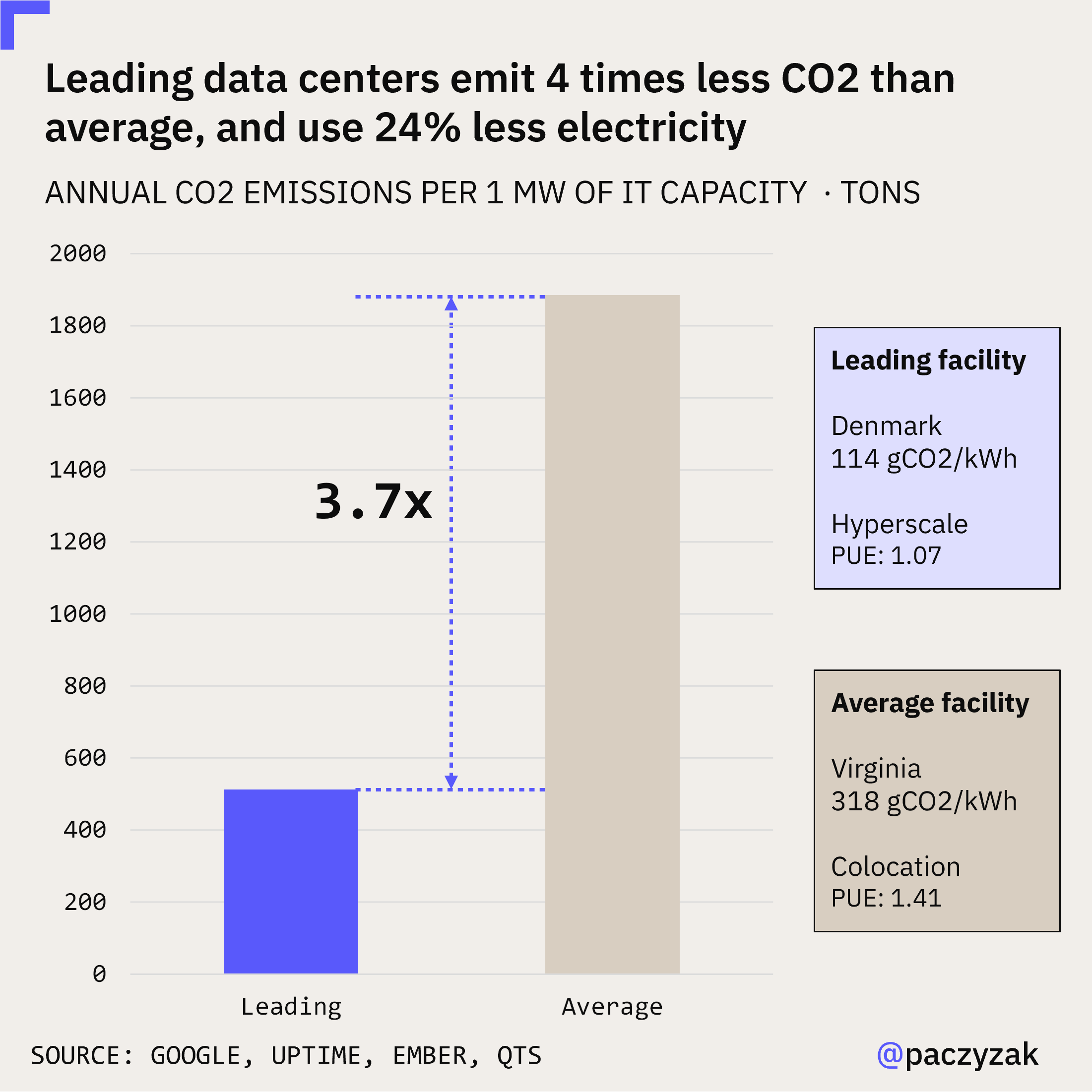
Yet, Google’s fleet average is now down to 1.09. The facility in Fredericia, Denmark, hit 1.07 over the last 12 months. That means it consumes 24% less electricity than the global average data center. At 120 MW of capacity, it’s 7 million euros in annual savings, assuming a cheap wind/solar PPA at 40 EUR/MWh (Denmark), and at least twice that at wholesale market prices.
In general, hyperscale data centers hit much better efficiency scores. Even the Colossus, despite it’s rather tragic power supply arrangement, is likely much more efficient that some older colocation data centers.
Put your data center where power is cheap and clean
The carbon emissions intensity of power supply is the second piece of the puzzle. Many hyperscalers run on ~100% clean power (there are different consumption matching arrangements). The bigger part of the pie - colocation data centers, not necessarily. Often it’s a mix of PPA, grid-power, on-site generation (clean or not).
If you’re sourcing power from the grid, location matters for two reasons. One is obvious - in places with lots of renewables, your energy will be cheap and clean. In places with less renewables, power will be more expensive and your data center will emit more carbon.
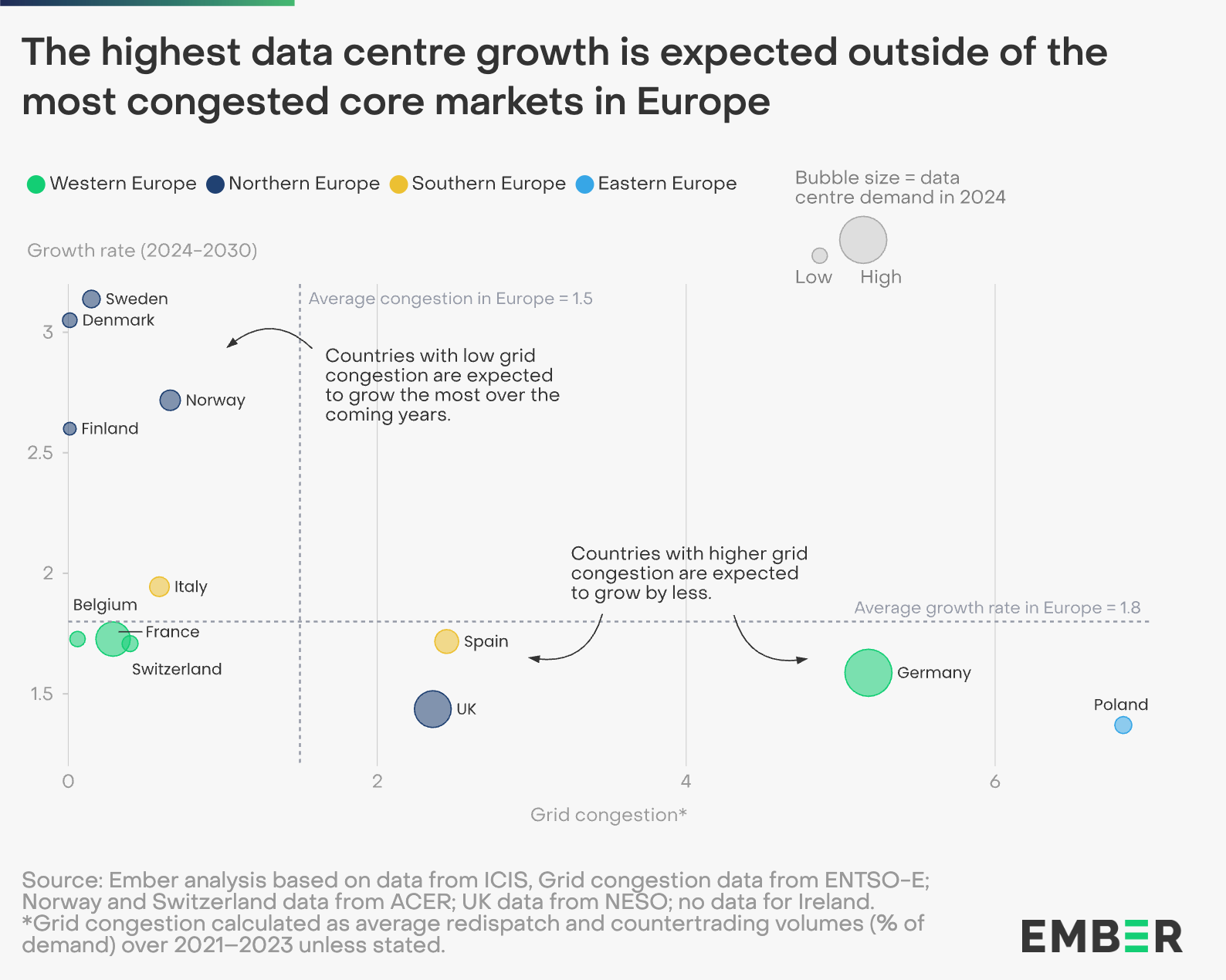
The other reason is grid connection - countries and even specific locations in certain countries have very different grid conditions. We wrote a whole report about it last year. The findings were clear - data center developers are moving to places where grid access is better, like the Nordics, avoiding very congested regions like Frankfurt or London - historically the main data center hubs in Europe.
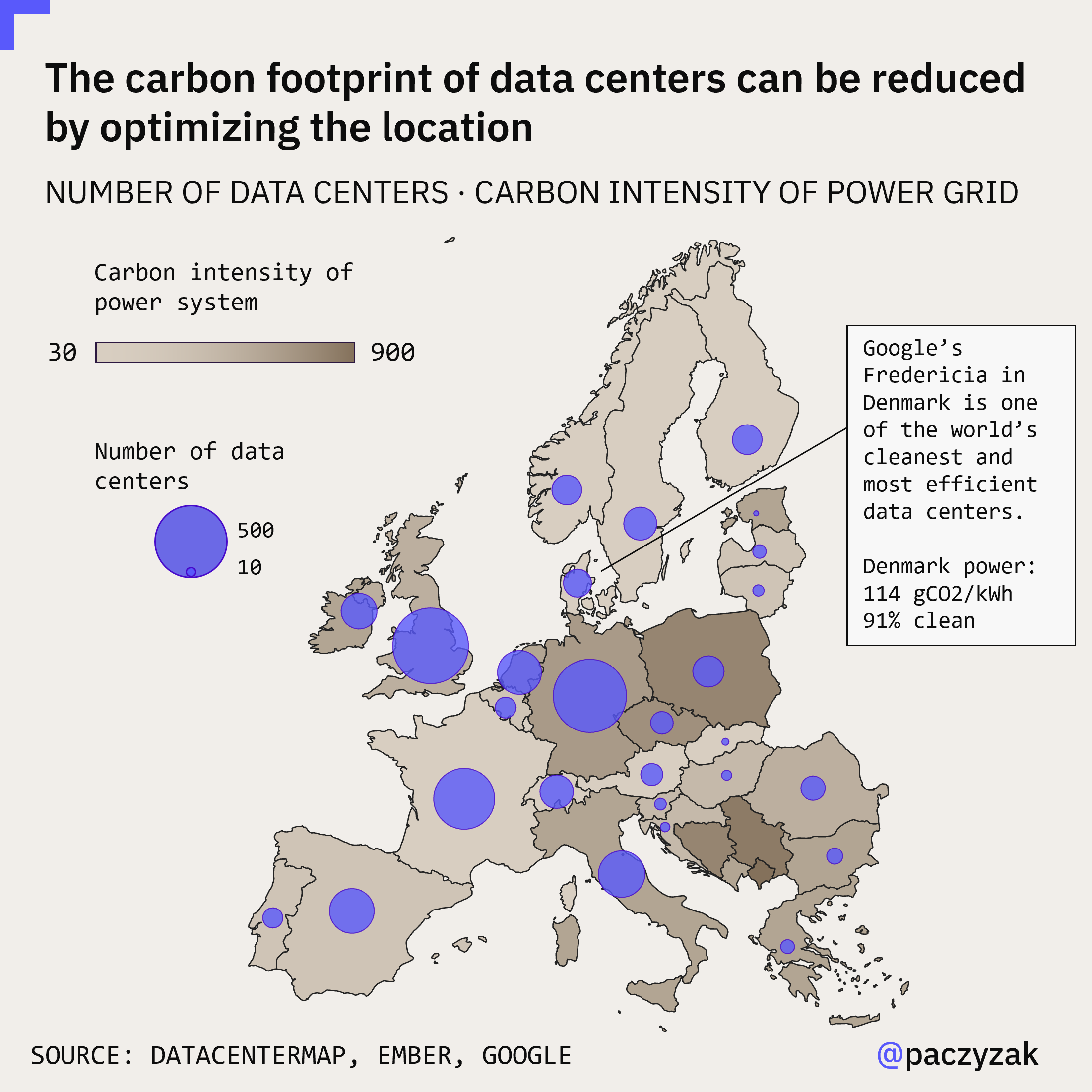
But back to the first factor - the power mix. Within Europe, the carbon intensity of electricity varies a lot. Many leading countries get scores below 150 gCO2/kWh: the Nordics+Denmark (hydro, wind, nuclear), Baltics (wind, hydro, bio), Switzerland and Austria (hydro), France and Slovakia (nuclear), Portugal and Spain (wind, solar), Belgium (wind, solar, nuclear).
You also have places like Poland or the Western Balkans - scoring around 600 gCO2/kWh or more, followed by Czechia around 400, with electricity systems heavily reliant on coal and/or gas.
These “dirty” countries were never key data center hubs. But they could be in the future. However, considering the population, size of the economy and size of IT workforce, they are not seeing the levels of investment we’d expect, especially comparing to the Nordics, or even neighbors like Hungary, Slovakia and Austria. In the clean-powered countries, the data center electricity demand is expected to grow 4-5 times between 2024 and 2035. In Poland and Czechia, this is 2-2.5x. This is partially because of low grid availability, but also because of the power mix.
This is no different to e.g. the case of two Mercedes factories in Poland that were only possible thanks to solar on the roof and a PPA with a wind farm. The economics are simple: a solar PPA in Germany is ~65 EUR/MWh, but the monthly average wholesale market price varied between 65 and 110 EUR/MWh in the last 12 months, and will likely get much higher due to the war in Iran.
Summarizing: there are very different approaches to data center buildout, some much better than others. If you pick a location with abundant clean power, good grid access, and you optimize the efficiency, the running costs and climate impact of a data center can lowered multiple times compared to an average industry standard. And if you’re, say, the government, and want to attract AI investments, you need to make sure there’s plenty of clean power available.
Thanks for reading! If you’d like to get similar stories on your email every Wednesday, subscribe below:
Interesting piece. Annual average carbon intensity is a reasonable proxy at scale and for cross-country comparison it clearly works. I wonder though whether for an always-on load, marginal time-matched emissions might be a more accurate lens? Would be curious whether that changes the leading vs. average gap materially.