
Grids (and data centers)
Connecting data centers to the grid + new data on enersite.app

Today, Ember launched a new report on grid capacity in Europe. It’s a good opportunity to talk about grids. Grids are critical for the deployment of clean power on the supply side, and electrification and data centers on the demand side. And I have a little surprise for you. But we’ll get to that.
Grid capacity and why it matters
Grid capacity is a measure of how much stuff can be integrated with the grid. It’s usually reported in the context of renewables - saying how much wind and/or solar you can connect to the grid at a given substation.
This data is quite difficult to find and process, so Ember comes to the rescue. Latest analysis reveals that Europe’s grids are not ready for the expected volumes of clean power. In the largest renewables markets like Spain, France, Poland, the Netherlands (Germany and Italy don’t report the data), grid availability is far below the renewables capacity these countries are planning to deploy. At least 120 GW of renewables projects are at risk. This concerns rooftop solar too, potentially blocking 1.5 million households from becoming energy prosumers.
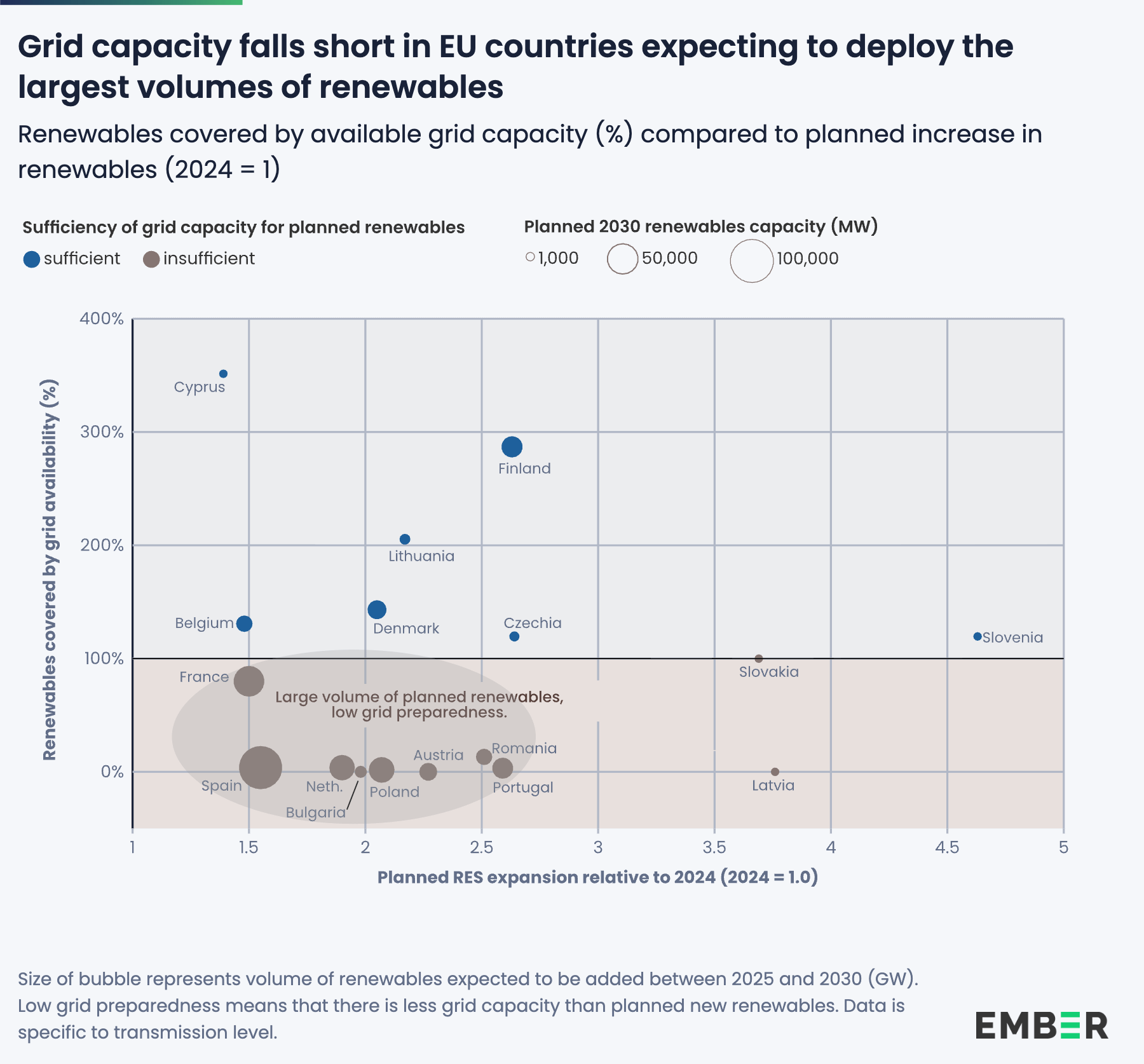
There’s an electrification story there as well, because grid capacity matters for both supply and demand. While the grid situation on the demand side is generally better than in the case of renewables connections, it’s not all great. In the worst cases of Poland and Spain, the lack of distribution grid availability could pose a major challenge to heat pump deployment.
Connecting a data center to the grid
And then there’s the industrial demand story, which includes data centers.
Data centers already have huge issues with grid connection. Data center deployment in key hubs like Dublin, Frankfurt and Amsterdam has been brought to an almost complete halt due to grid availability constraints. It takes years to connect a data center to the grid.
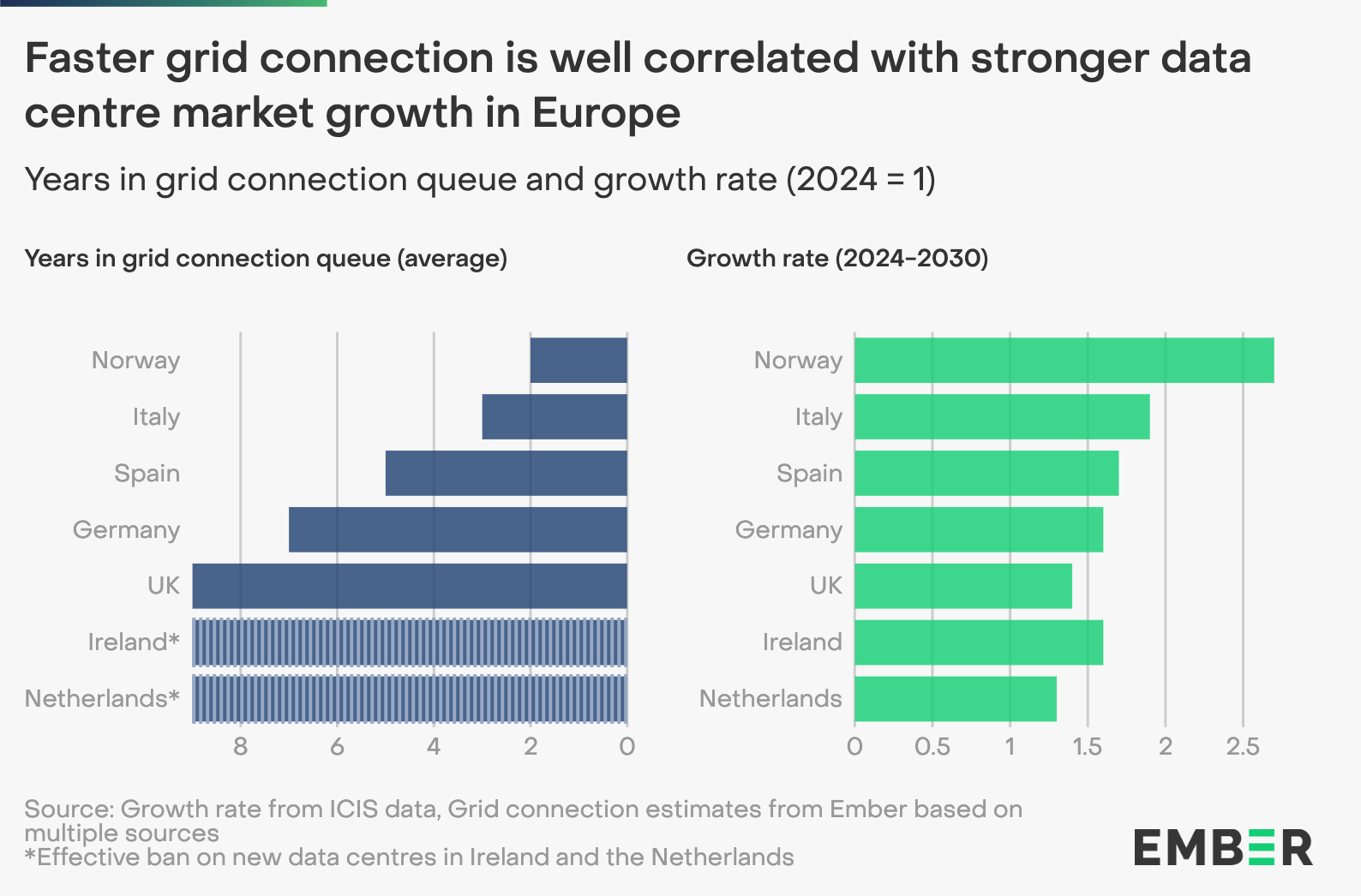
This is also reflected in the grid capacity data, although the data coverage is low. On the industrial demand side, at the moment grid capacity availability is reported only in a few countries: Czechia, Belgium, Latvia, and the Netherlands. Austria, Bulgaria and Romania report zero transmission-level capacity for new loads.
Some governments have taken steps to unlock grid capacity for data centers, both to attract investments and reduce their potentially negative impacts on energy markets and infrastructure.
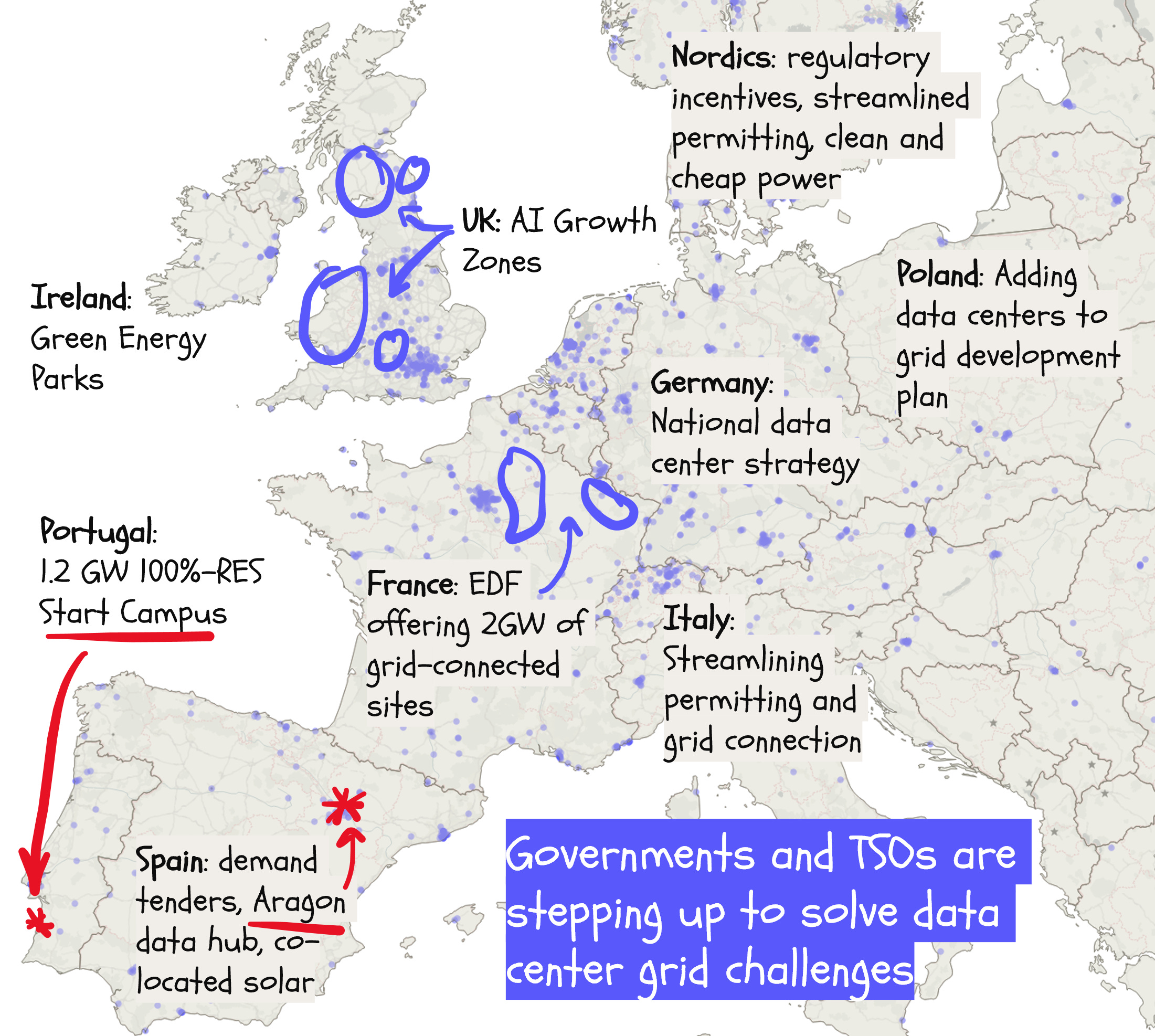
To name a few examples:
UK: AI Growth Zones. A flagship program that marries power demand and supply, optimizing grid usage and offering multiple incentives for developers
France: EDF is offering data center sites. 2 GW of grid-connected sites, ready to use, with an electricity supply offer included
Germany: National data center strategy published 2 weeks ago. Improving grid connection procedures and data availability, promoting flexible connection agreements. But also pushing for better efficiency and clean power supply.
Ireland: Introducing Green Energy Parks as part of the Large Energy User Action Plan, incentivizing co-location of data centers, renewables and storage
Spain and Portugal: expanding flagship hubs like Aragon and Start Campus with ~100% renewable power supply (also on-site), plus launching demand tenders
Italy: passing decree 21/2026 streamlining data center permitting and grid connection
These solutions incentivize the placement of data centers close to renewables (+storage), for the cleanest and cheapest power supply, minimum impact on national power grids, and quickest deployment times
The surprise: new data on enersite.app
To help you analyze the multiple factors important in data center planning - across grids, power supply, cost, I’ve added a few datasets to my data center app.
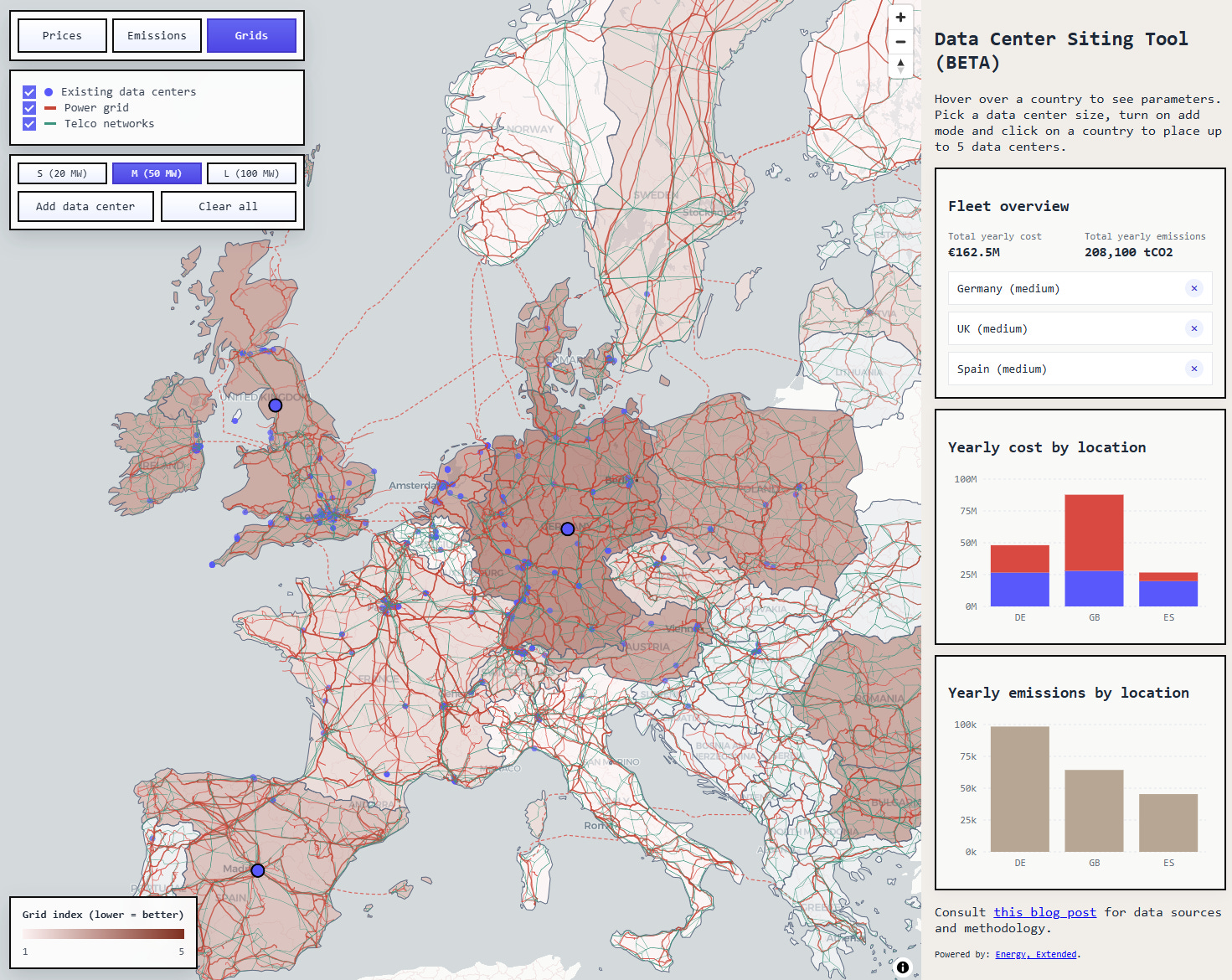
We now have:
Grid capacity for industrial loads (current)
Grid congestion (2025)
The data comes from Ember and the coverage is limited due to uneven reporting by grid operators. To simplify the assessment, I combined these metrics into a score (I called it Grid index) that provides a rough overview. You’ll find the full methodology here. In short - the best scores (grid index = 1-2) are for countries with quick connection times, low grid congestion, proven grid capacity: Belgium, Latvia, the Nordics. France, Italy and Czechia score well too. On the other side of the spectrum (grid index = 4-5) are Germany and Austria, the UK and Ireland, Poland, the Netherlands - with high grid congestion and/or long connection times and/or reported lack of capacity. This is subject to many disclaimers and by no means a scientific metric. Please consult the methodology document for more detail.
If all that isn’t enough, in this update I’ve added one more nugget: total electricity costs, including network charges and levies. Again, there are multiple assumptions here, but the early results are quite surprising. For example, the UK and Germany might have similar wholesale power prices, but the total costs in the UK will be way higher due to overheads (I know the government is doing many things to change that, so this will have to be updated regularly).
Hope you’ll find it useful, let me know what you think in the comments or on LinkedIn!
Thank you for reading!
If you’d like to receive similar stories every Wednesday, plus (occasionally) early updates on my data center app project, subscribe below:
This is great! One challenge is that “hosting capacity” sounds more definite than it really is: hosting capacity can vary greatly over time (diurnal and annual cycle as well as longer term trends), it depends on whether you mean supply or demand, and methodology varies between grid operators. In a previous life, I worked on a change to the Australian National Electricity Rules to standardise hosting capacity mapping across the National Electricity Market and to require distribution networks to update hosting capacity maps more frequently (or to make them public at all).
Korea’s version of this bottleneck is not just data centers but semiconductor fabs. The Yongin cluster alone, where Samsung and SK Hynix are building next-generation chip production, needs up to 15 GW of firm power concentrated in a single grid corridor. No European data center hub comes close, and unlike data centers, fabs cannot relocate to wherever grid capacity happens to be available. The semiconductor supply chain dictates the location.
And the data center wave is coming on top of that. Korea signed a deal for over 250,000 Nvidia Blackwell GPUs last year, aiming to become the world’s third-largest GPU hub after the US and China. Data center IT load alone is projected to hit 6.3 GW by 2030. Stack that on top of the semiconductor demand and Korea is looking at over 20 GW of new load on a single isolated grid with peak demand around 90 GW. Outside the US and China, no single country is concentrating this much new energy-intensive demand onto one system.
At this scale, the problem goes beyond grid connection capacity. Adding 20 GW to a 90 GW island grid with zero interconnection is not something you solve with smarter connection queues or co-location with renewables. You need firm generation, frequency control, and inertia. Solar and wind do not deliver that. Pumped hydro and BESS handle balancing, not baseload of this magnitude. What Korea needs is multiple turbine-based generators feeding directly into the corridor. This is no longer a grid capacity problem. It is a system stability problem.