
A quick guide on how to manage data center grid connection queues
Last updated: July 7, 2026
Managing data center grid connection queues is becoming a top priority for grid operators, as shown by recent developments: the FERC and ERCOT actions in the US, or the Energinet moratorium on data centers in Denmark.
This is overview of data center connection queues - the challenges and the solutions. It’s quite urgent if we want to avoid negative impacts on both the AI and the energy side of things.
The scale of the issue
Grid connection queues are not a new thing. Tens of gigawatts of renewables have been stuck in them for years, and initiatives like the EU’s Grids Package proposed actions to resolve that.
But now we have queues forming on the demand side, which makes it even more difficult for planners: how do you design your power system if you don’t know what the demand will be? Especially if your connection queue exceeds the country’s peak power demand, like it does in Poland, Italy, Denmark, Finland.
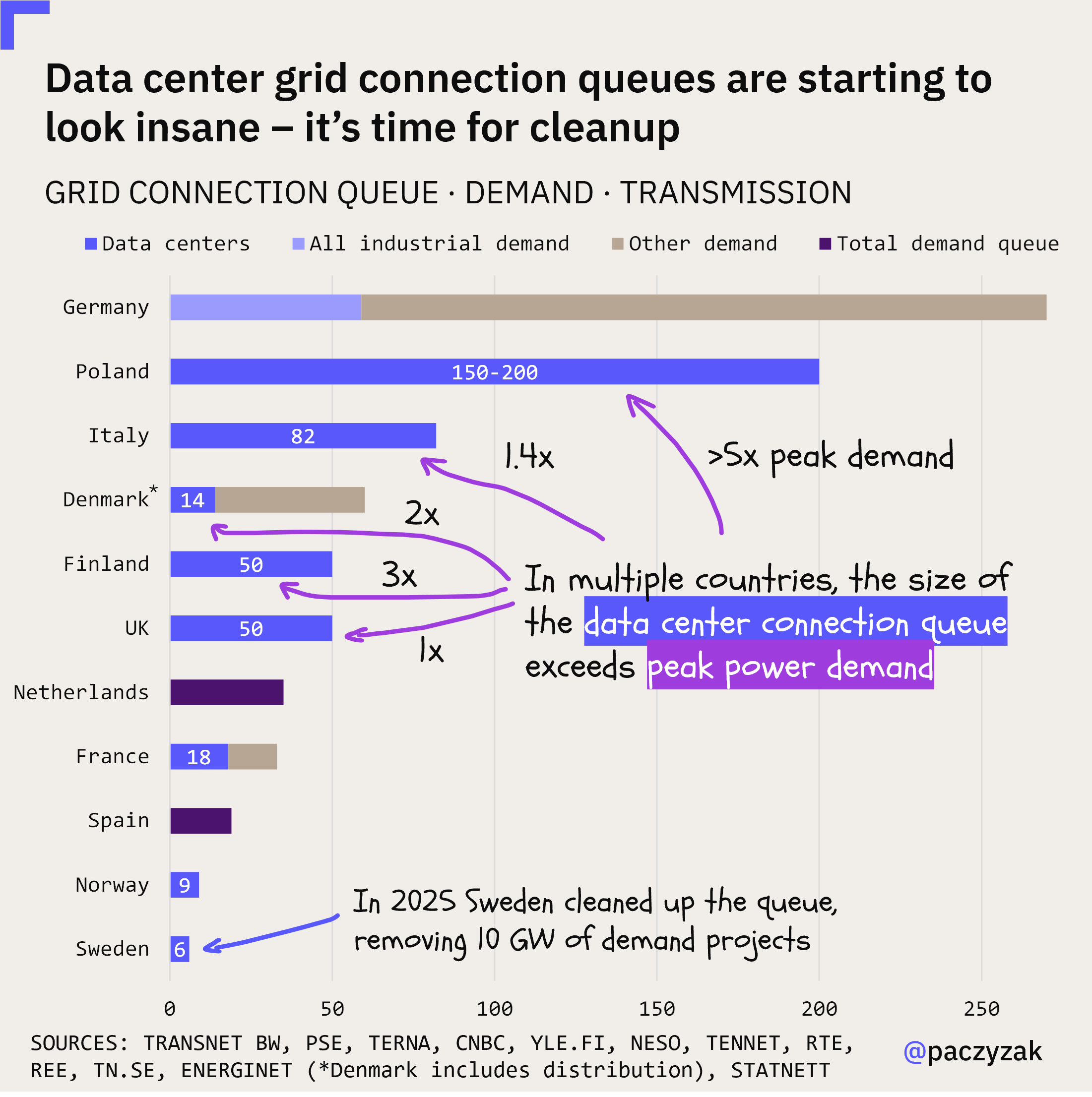
Getting into specific examples. In Germany, there’s a TSO-level queue of 270 GW, 211 GW of that being big batteries, the rest bundles up data centers, industry and electrolyzers. In Poland, the data center queue alone is 150-200 GW. In a country where the current data center capacity sits around 200 MW, the peak power demand is around 30 GW, and half of the electricity still comes from coal.

Italy is a bit similar. In March, the grid operator - Terna, said they got 82 GW of applications, yet are only expecting 1.5-2 GW to materialize by 2030. The operator is flagging intense speculation: developers trying to increase the value of land by submitting data center grid applications.
In Denmark, around 60 gigawatts of new electricity consumption projects are waiting for connection to transmission and distribution grids. Which is 9 times the country’s 7 GW peak power demand. Triggering a temporary pause on connections from the operator Energinet.
Finland and UK sit at 50 GW. Interestingly, Fingrid is actually planning for a massive increase in industrial data center and electricity demand - reaching up to 100 TWh by 2035 - which is more than the whole country consumes today.

Here’s a summary table with many caveats (and some more caveats below).
A note on the data
It’s very tricky to compile data on this because each operator reports a slightly different metric. You have to separate generation and demand queues, transmission and distribution, and then understand what’s actually captured under the demand. For example in Germany there’s a 600 GW figure floating around of DSO-level battery project submissions, and people mix that with the transmission-level numbers. In France, the 18 GW I put on the chart are pre-planned data center connections, so they’re a much more strict number than the unverified queues in Poland or Italy. I’ve provided all the sources and tried to describe what each number tracks, but it is far from perfect.
One action point from this is that we clearly need better data.
Solutions and best practices
Some grid operators have already moved to manage their connection queues, and best practices are starting to emerge.
Recently, the actions by FERC and ERCOT in the US were widely covered. Already in 2023, the Federal Energy Regulatory Commission (FERC) started a reform of the connection management process, moving from the first-come, first-served approach to a first-ready, first-served one.
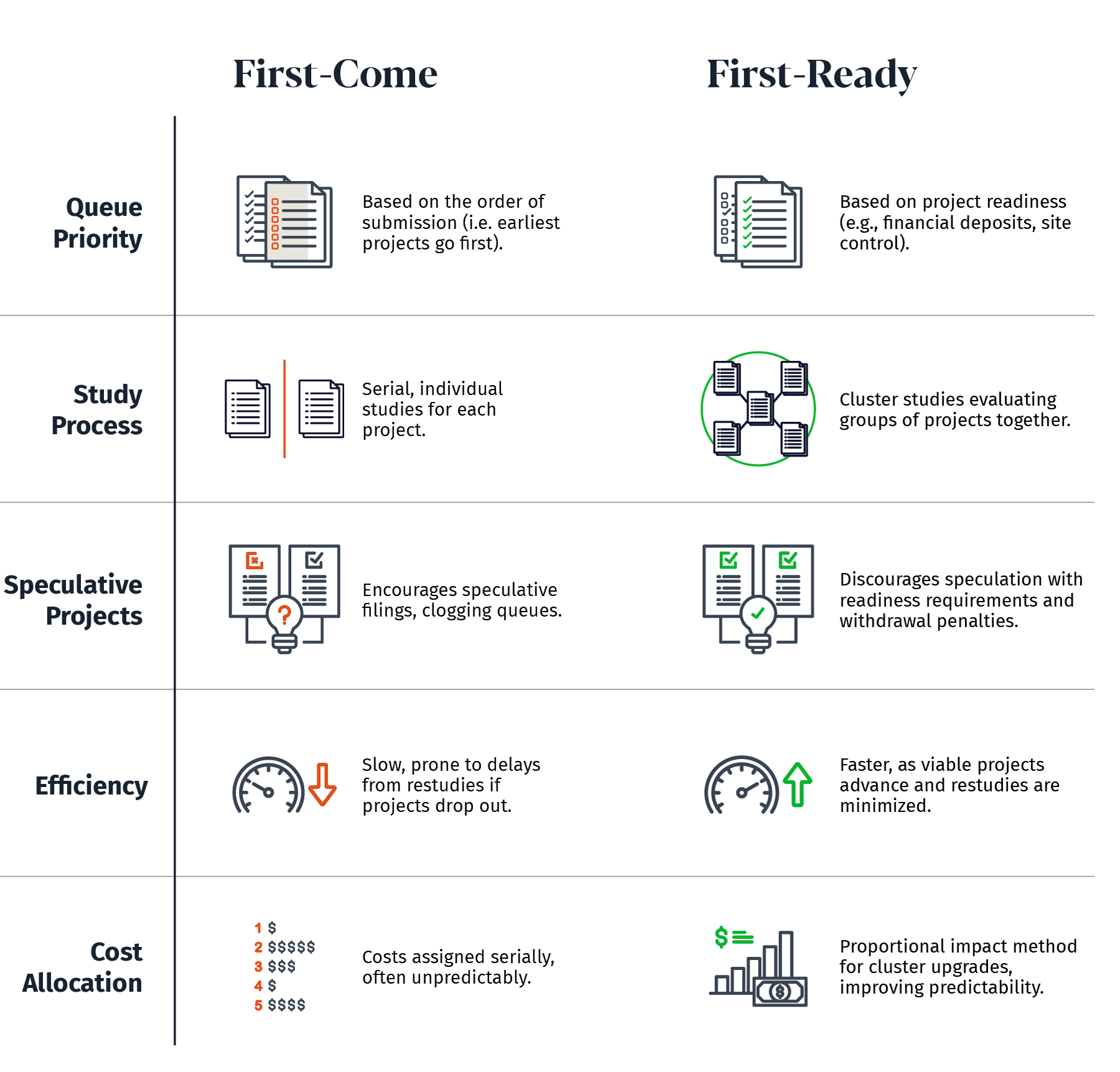
This prioritized projects with proper financial and technical backing, required upfront deposits, and helped the operator cluster the grid studies - so run the costly models for a group of projects, rather than each one separately.
In October 2025, the Department of Energy asked FERC to basically do the same for demand, resulting in the June 2026 Aggressive Targeted Action to Speed Large Load Integration. Several areas were outlined, including improving the application and study processes, accommodating co-location and behind-the-meter generation, and support for data center flexibility. Texas recently approved changes along similar lines, aiming to select a “Batch Zero” of most advanced projects, analyzing them as a group, requiring upfront study fees ($100,000). Projects now need to provide financial (land ownership/lease) and technical information (50% on-site backup), including dynamic load behavior (ramping up and down, frequency response, ride-through options). An earlier bill called SB6, introduced last year, already requires data centers connecting to ERCOT to demonstrate load flexibility - curtailing power during emergencies.

In Europe, it’s also a story of reactive rather than proactive planning. Ireland, Netherlands, Germany, UK - the historically leading data center markets, all faced challenges with data center integration, forcing them to reform the grid connection processes. Denmark faced this recently, issuing the halt on new connections.
Some of the solutions these operators are implementing to tackle the demand connection queues:
Ireland: prioritizing large data centers with on-site or near-site generation and/or storage (participating in the power market, not just BTM) and those ready to provide flexibility. Additionally, 80% of annual electricity demand must be met by additional renewable generation in Ireland within six years. In the long term, the Large Energy User Action Plan signals a more targeted siting model, where data centers would be located closer to offshore wind parks.
Netherlands: prioritizing consumption projects with “social function” - ones that alleviate grid congestion (through offering flexibility or adding batteries) or provide public services (hospitals, police). Interestingly, there’s also a clause about checking whether operators actually fully utilize the grid connection - if not, the connection capacity can be reduced.
Germany: applications are collected and assessed in fixed cycles against verifiable criteria and likelihood of realization, replacing chronological processing (Reifegradverfahren). The efficiency law also sets waste-heat reuse rules and renewables requirements (100% from January 2027).
UK: a demand connections reform is underway, aiming to prioritize the most advanced projects, incentivize phased and non-firm connection agreements plus data center flexibility, linking also with the wider AI strategy and AI Growth Zones.
Other interesting approaches include:
France: 18 GW of grid capacity were pre-allocated for data centers, and a first-ready, first-served principle is being rolled out in 2026. A fast-track is also available for strategic projects - with specific powered sites available for gigawatt scale data centers. Similarly to the Netherlands, the operator RTE can also reduce a connection capacity if it's not being utilized.
Finland: Fingrid’s connection agreement procedure requires projects to hold a legally valid zoning plan and building permit before a connection agreement can be made - similar to Germany’s Reifegradverfahren. There’s also a concept of high-value-adding data centers - with proven job and economic benefits, high efficiency, heat-recovery. Somewhat separately from the connection queue, but in 2026 Fingrid also published technical requirements for large loads - a good reference e.g. for ramping conditions.
Sweden: a hybrid approach by the TSO Svenska Kraftnät: first-come, first-served is combined with strict maturity level requirements and projects lose their allocation if they do not show progress, or if duplicates are detected. Technical requirements include information on flexibility, on-site generation and storage, phased connections. A feasibility study fee is charged upfront.
My top 10 recommendations
Move to first-ready, first-served (or a hybrid approach like Sweden). Rank projects on verifiable maturity and progress, not application date.
Demand real financial skin in the game. Meaningful non-refundable study fees, per-MW deposits, and withdrawal penalties that scale with capacity requested. Texas’s $100k minimum study fee and $50k/MW interconnection fee are the benchmark to deter speculation. This also helps fund the massive cost of the modelling done by the grid operator.
Eliminate duplicates. Mandatory disclosure of parallel requests.
Group the analysis and run it on fixed cycles. Accept applications in periodic windows and assess them together against available capacity, optimizing the modelling and removing bottlenecks if one project gets stuck ahead of others.
Ask for maturity-level confirmation: no queue position without proof of land ownership or a lease agreement.
Fast-track for non-firm and flexible connections. Non-firm connections, where users accept potential curtailment under specific conditions, get priority because their impact on the grid is lower.
Recognize societal value. Prioritize projects with proven benefits - job creation, economic value, innovation, district heat generation, and projects related to national security and public services. Needs clear and defensible criteria, but such policies are already present in Finland and the Netherlands.
Reward projects that bring their own generation and storage. Such criteria are already present in Ireland or Germany. This can convert data centers from grid burden into net system contributors (if 24/7-matched).
Publish capacity maps and connection queue data. The more data is available, the better developers can respond to it - moving to sites with more grid capacity / less projects in the queue.
Shift from reactive queue management to strategic siting. Something I’ve covered in the past - rather than dealing with queues, fast-tracking data centers that locate where there’s already grid capacity and clean power supply. Like Ireland’s LEAP, UK’s AIGZs, France’s powered sites.
For more analysis like this, subscribe to my weekly newsletter: