


This is part 2 of my quest for grid-positive data centers in Europe. Today we’re doing an intro into waste heat recovery – one of the, in my opinion, biggest levers data centers have that unlock very tangible benefits for their neighbors (i.e. households).

And straight away I can tell you things are not as simple as we’d like them to be.
If you are working on waste heat recovery, please reach out - I’d like to partner on a deep-dive, since there’s many aspects of this that need further analysis.
Europe’s district heating system is vast and growing
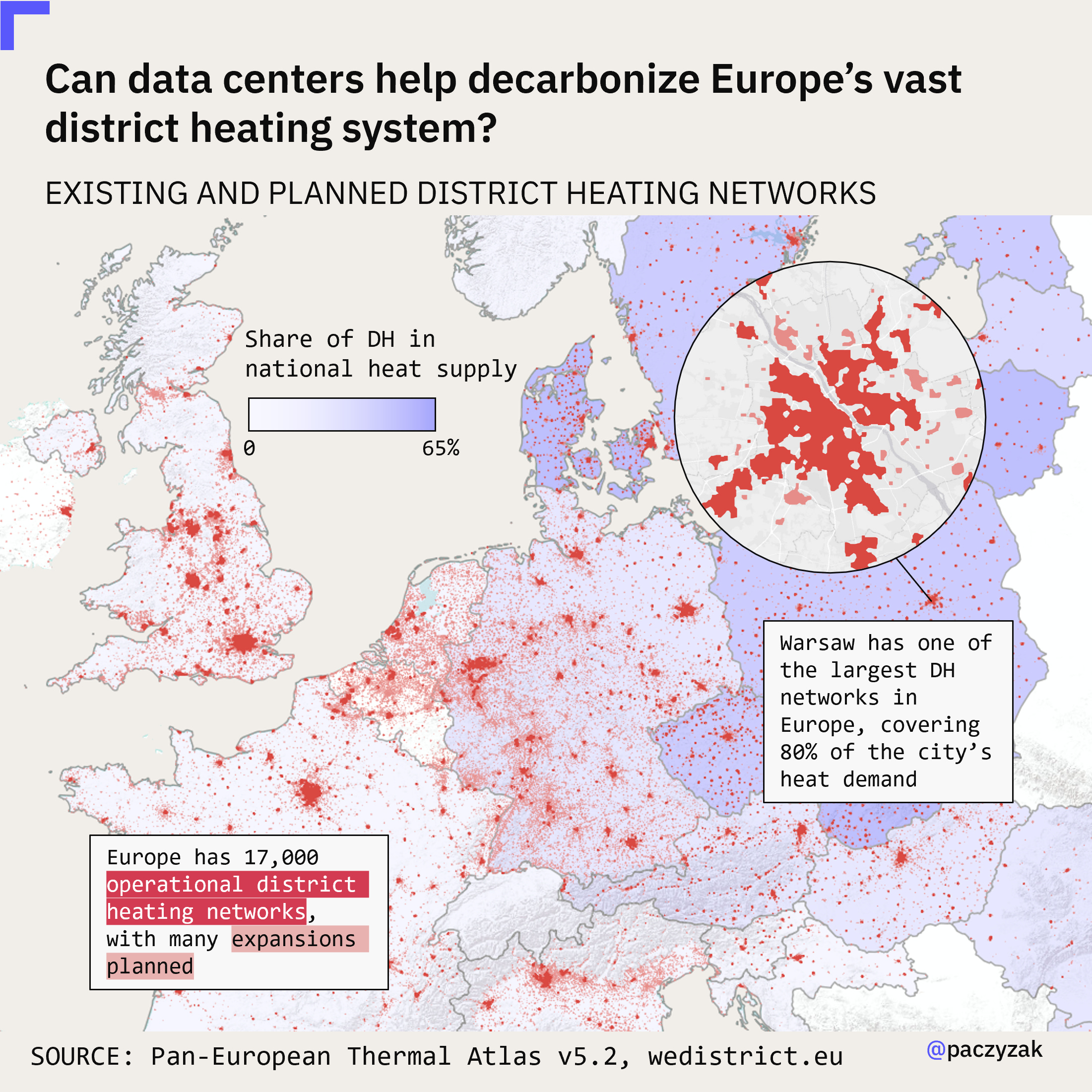
Europe operates around 17000 district heating networks. The penetration of district heating varies a lot by country – it’s almost zero in Iberia, generally very low in the Western parts of Europe, and very high in the Nordics, Baltics and Eastern Europe. The top performers are Denmark, where 65% of heat supply is covered by district heating, Estonia, Lithuania, Sweden, Slovakia all sit around 50%, Poland, Czechia and Finland around 40%.
Why is district heating great?
It removes the problem of individual households having to heat themselves with old-school tech like gas boilers, which use a lot of space, require maintenance, cause safety issues (gas leaks). It also lowers air pollution, especially if the alternative is to burn something (coal, wood, tires) in an even-older-school furnace.
Because of all the above, most cities are expanding their district heating networks. One example is Berlin, scaling from an already massive annual heat supply of 9.6 TWh to 12.1 TWh by 2035 (gross).
Warsaw is another example – it’s one of the largest DH systems in Europe, at 11 TWh today, covering 1.4 million citizens with a network of 1800 km. Vienna is another big DH network of around 7 TWh.
Decarbonizing heat
Decarbonizing heat supply has been a bit slow. Warsaw’s system still partially runs on coal and is being switched to gas. Berlin runs mostly on gas, and still packs some coal too! Vienna is gas+waste.
On the up side, transition scenarios are being executed. Vienna’s 2040 “Phasing out gas” strategy is a masterpiece. Although I’ve been brainwashed during a visit at Vienna’s waste incineration plant :D
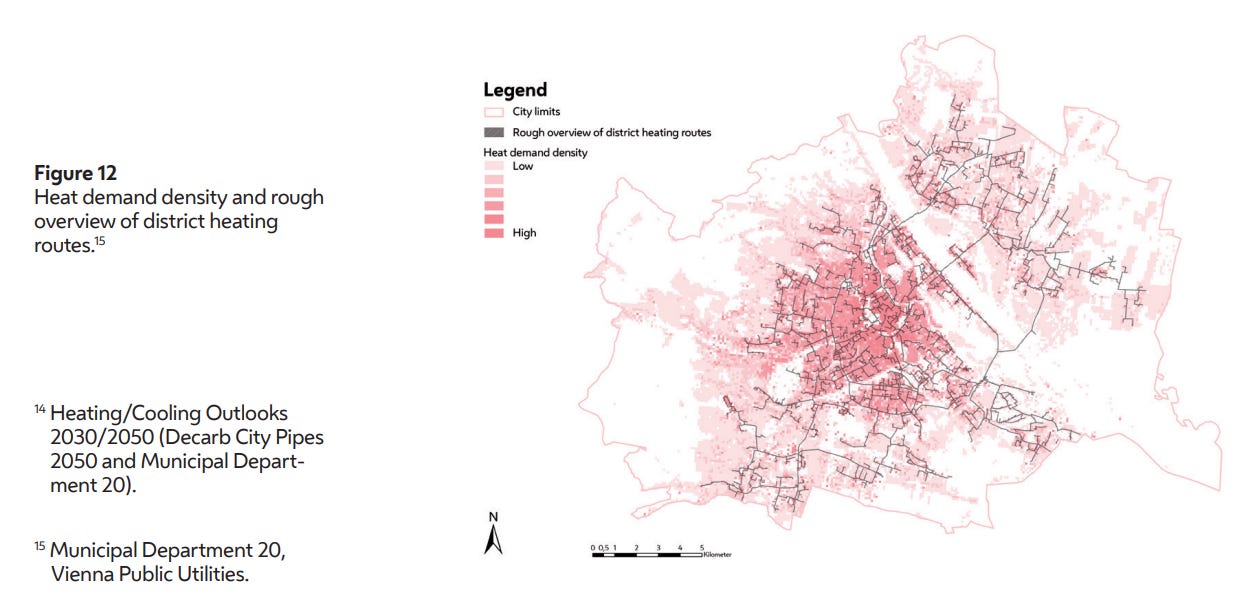
Berlin has a serious plan too, planning for the major expansion of the system, but still covering 50% of heat with gas in 2035. Warsaw is basically going for a 1:1 coal to gas replacement.
Can data centers decarbonize district heating?
The district heating systems we’re talking about here are huge. Their peak demand could exceed 3 GW in winter. You’d need a ridiculously big data campus to cover that, and you’d waste the vast majority of that heat anyways during summer – because the data center runs a flat yearly profile, while the heating demand is highly seasonal.
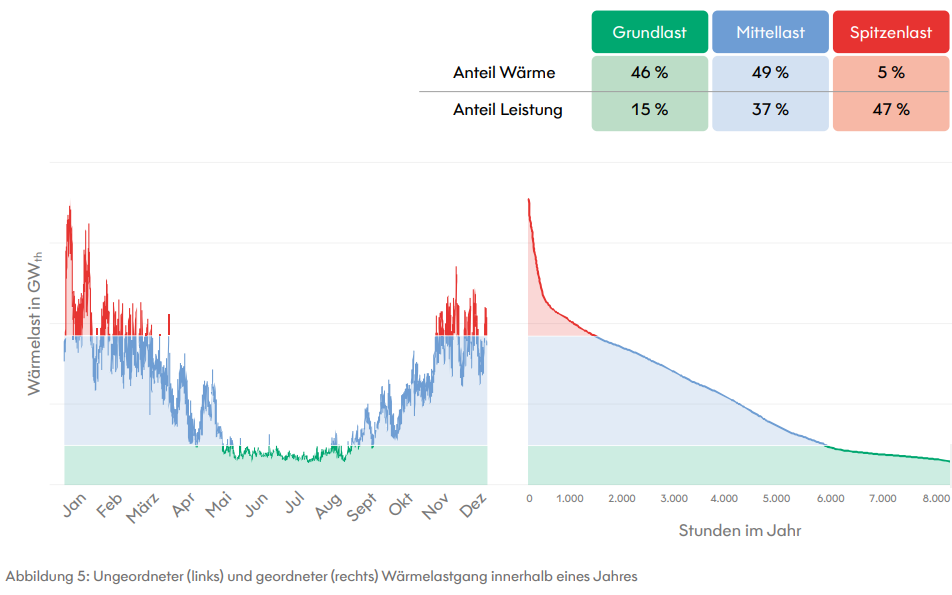
That seasonality is key, and nicely demonstrated in the Berlin strategy. Almost half of the annual heat demand is delivered by baseload sources, that contribute only 15% of installed capacity. The other half of the volume are intermediate sources, running 1500-6000 hours per year. And then peakers contribute half of the capacity, but produce only 5% of the annual heat. Obviously, data centers fit the first bucket best.
During summer, heat isn’t generated, so baseload sources are used for hot water and it makes limited sense to oversize them.
The sweet spot is what Microsoft and Fortum are doing in Espoo. The data center is sized to deliver around 40% of the annual heat demand, so 75% of the data center’s waste heat can actually be utilized. This covers baseload, with additional heat pumps, electric boilers and peakers taking care of the rest.
Sizing the data centers
If we follow the Espoo sizing rules and look at the monthly heat profiles for the three cities (which I modelled from Eurostat’s heating degree days for 2019-2025, hot water shares of 10-20% depending on city, and I scaled demand to 2035 according to the transition scenarios), we’d need a baseload heat supply of 400-700 MW.
But all our cities already have plans for the baseload part, in the strategies I mentioned above. Around 300MW of sewage heat pumps and waste incineration in Warsaw, around 600 MW in total in Berlin, from heat pumps, geothermal and waste, and Vienna aiming for no gas by 2040 anyways.
In Vienna, the data centers would compete with the other clean heat technologies, not sure that makes sense…
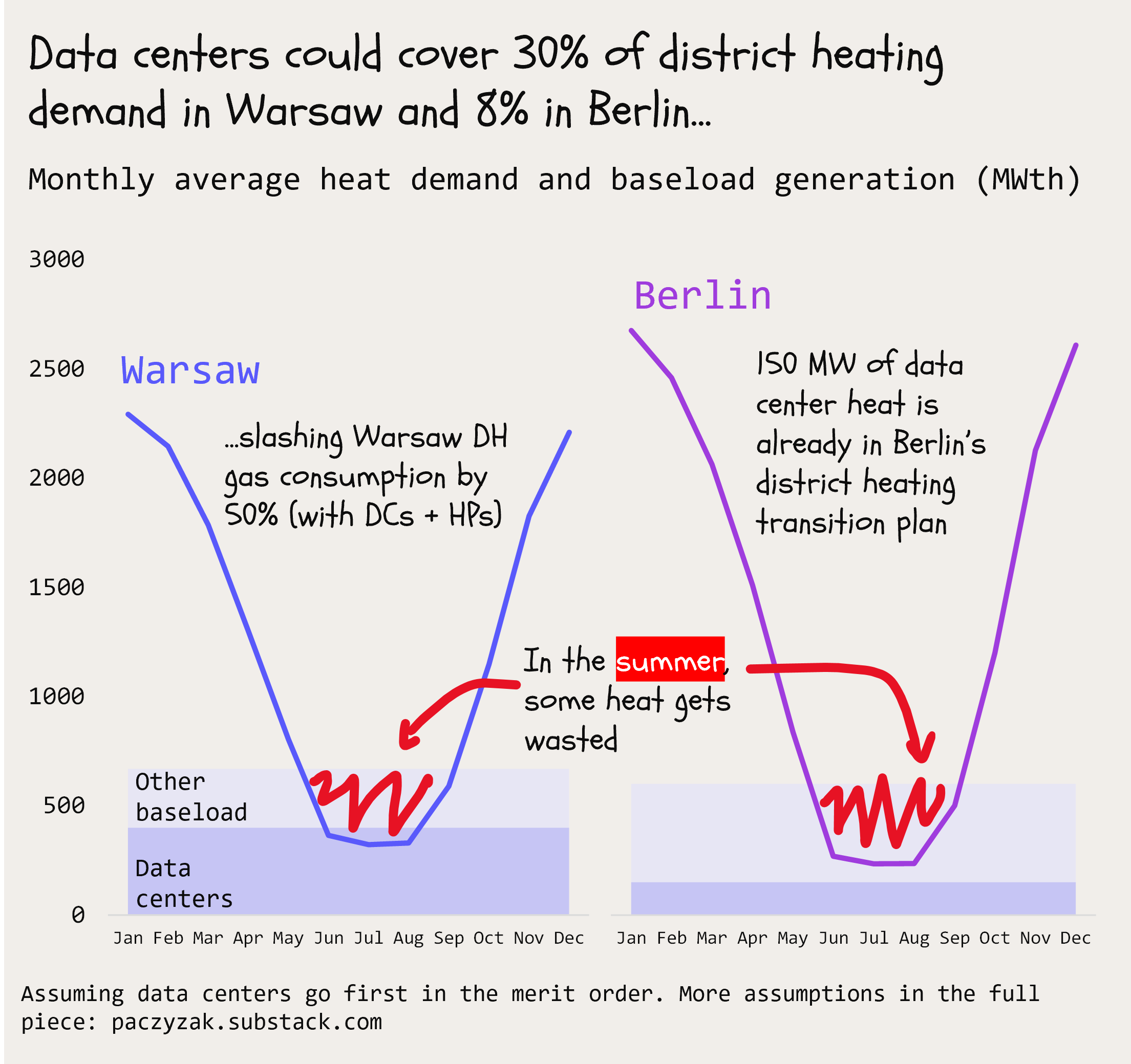
In Warsaw, we’re looking at around 400 MW of data center heat potential, meeting ~25-30% of annual heat demand, and utilizing ~75%-85% of the data center’s waste heat supply (depending who is first in the merit order). The good news is that we’d potentially slash gas consumption by half (combining the data centers and running the sewage heat pumps at higher utilization).
Berlin’s strategy already assumes ~150 MW of data center heat by 2035 (inside the heat pump total), so there’s clearly some wisdom in all this. That’s 8% of the annual heat demand, at 75% utilization (assuming they run as baseload), and a 12% reduction in gas consumption. Adding more data center capacity does cut more into gas, but the utilization of the waste heat drops too (unless there’s seasonal thermal storage).
A few more catches
For all this to work we need a few things.
While almost all data center electricity gets turned into heat, it’s really only recoverable (up to 90% of the IT heat) in a liquid cooling setup (so in more modern facilities).
That heat comes out at 30-45 degrees. For district heating we need 70+ degrees. So we use heat pumps to boost it. This adds about a third (COP 2.5-3) to the total electricity consumption, and someone has to pay for that.
And, of course, we’re assuming the data centers are located close to the district heating network, because transporting heat is tricky. And that’s a big “but”, because we also don’t want data centers close to power demand (so cities), to avoid grid issues and price spikes. Plus data centers need to be as clean-powered as possible, otherwise we’re swapping a gas CHP for a gas data center, just adding inefficiencies on the way.
Can data centers lower heating bills?
Ultimately, the question is: can a data center lower heating bills in a big European city like Warsaw or Berlin?
Potentially, yes.
If we, very optimistically, assume that the waste heat is free, and that the power for the heat pumps is also paid for by the data center (that’s a stretch), we could cut heating and hot water bills by ~15% in Warsaw. In Berlin, the 150 MW of data center heat would only cut bills by 5%, even in this optimistic scenario.
Of course, heating bills are going up. But there are so many caveats in these calculations I could write a book about them. Gas prices (assumed the current 70 EUR/MWh, the Warsaw savings drop closer to 10% at 35 EUR/MWh), the heat pump electricity cost, the data center power mix (and seasonal balancing), the heat tariff design, the CHP operation (currently also supplying electricity for the cities). It certainly needs a case-by-case approach.
This is work in progress
As I mentioned, this needs a lengthier analysis, covering more cities (smaller ones too) in much more detail.
My summary for now would be:
1. If you’re planning a data center next to a big city, consider plugging into district heating.
2. If you’re planning a greenfield data center far from a city, can you co-locate with an industrial heat offtaker?
3. If you’re a district heating system planner and there are data centers being built in the area, talk to them and include them in the DH transition plan.
4. If you’re a grid operator, consider waste heat recovery as a factor in the grid queue management process (more on that here).
5. If you’re a politician or policymaker, consider this as one of the ways data centers could bring tangible benefits to their neighbors. But caveats apply.
6. And an EU-facing recommendation: I think this is the one AI-related case where public funding might actually make sense (say covering the cost of the heat pumps, the heating connection, technical support).
Seasonality is exactly what most data-center heat pitches skip: a flat 24/7 heat profile against a demand curve that peaks in January. Your baseload point suggests the realistic role is a slice of the baseload, not decarbonising the whole network. Have you seen any city make heat offtake a condition of the grid connection or permit, rather than leaving it as a voluntary nice-to-have?
Calentix energy develop, finance and invest in data center waste heat recovery projects . We currently have 20 projects in our pipeline and we collaborate with some of the largest global datacenter companies.
Our co-funder Ulrika Jardfelt previously ran Vattenfall’s heat business, which includes the Berlin district heating network. I think you are too pessimistic on how much WHR can lower heating bills. Send me an email on markus.wrake@calentix.com and we’ll set up a chat.